
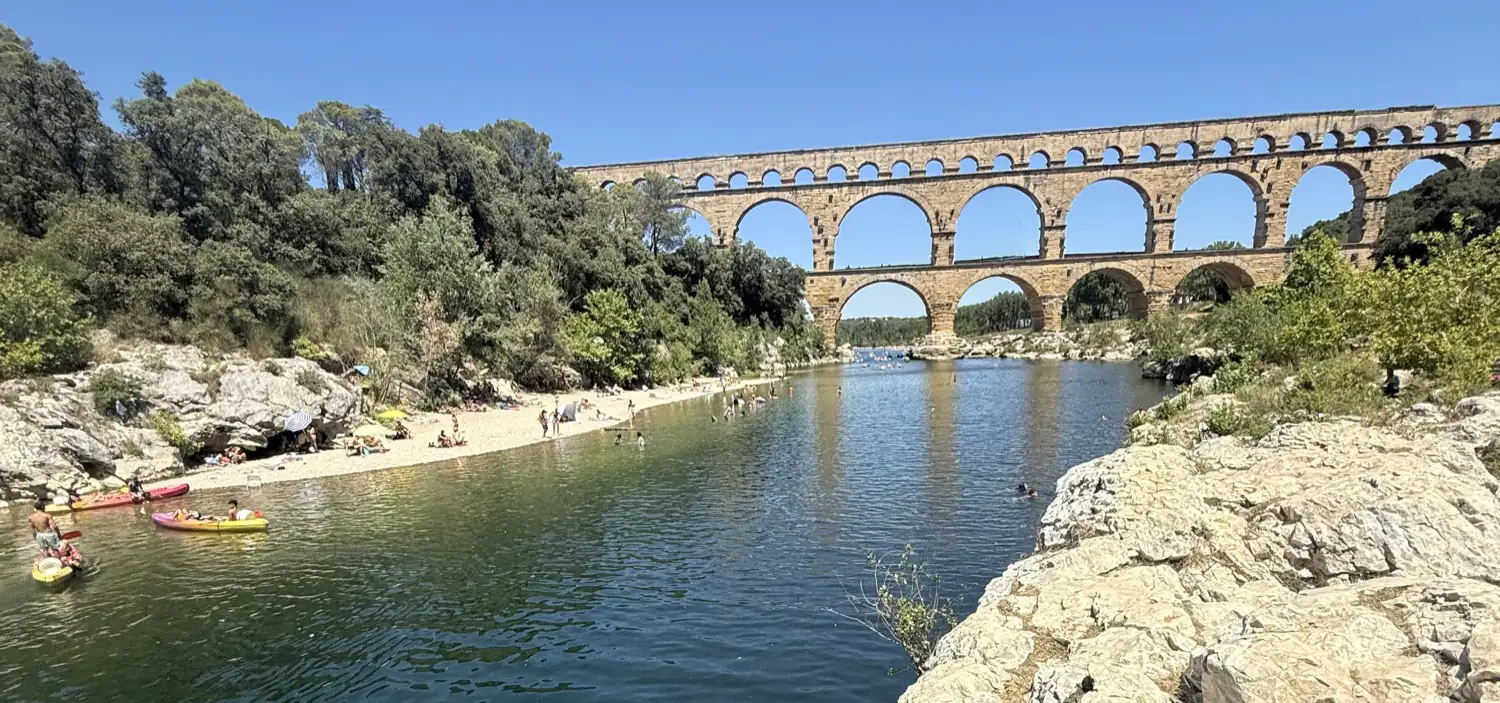
The Pont du Gard is one of the most impressive structures of antiquity: a Roman aqueduct spanning the river Gardon in three tiers of arches, almost 49 metres high. Less noticed, yet just as old in their own way, are its quiet neighbours – olive trees growing at the foot of the stone arches. Two of them have a special story to tell.
The Pont du Gard – Roman engineering
Built in the 1st century AD, the Pont du Gard was only one link in a water channel some 50 kilometres long that carried fresh spring water to the Roman city of Nîmes (Nemausus). Three tiers of arches stacked on top of one another, fitted without mortar, carry the actual water conduit at the very top. Since 1985 the structure has been a UNESCO World Heritage Site, and today it is one of the most visited monuments in France.

Around the monument stretches typical Mediterranean garrigue – lean limestone soils with holm oaks, box, wild thyme and, of course, olive trees. The discovery trail Mémoires de Garrigue lets you walk through this cultural landscape.
Three thousand-year-old olive trees
At the foot of the aqueduct stand three oliviers millénaires – three thousand-year-old olive trees. Over the centuries their trunks have turned into gnarled, twisted beings of wood that look grown rather than planted. According to the information on site, their origin goes back to the year 908; until the 1980s they stood in a barren, cold valley in Spain.


The three oliviers millénaires at the Pont du Gard – their twisted trunks and sprawling roots bear witness to more than a thousand years of growth.
In 1988 they were transplanted to the Pont du Gard – the first step in upgrading the site. That trees more than a thousand years old survive being moved is typical of the olive: it is practically indestructible.
Next to stones that have lasted two thousand years stand trees that intend to do the same.
How old do olive trees get?
Olive trees are among the longest-lived cultivated plants of all. Trees several hundred years old are normal around the Mediterranean, and individual specimens are considered to be more than a thousand years old. Because the olive keeps sprouting afresh from its rootstock, the root often lives far longer than the visible trunk – the tree “dies from the top” and regrows from below.
The tree of peace
Only a few steps away stands a second, younger olive tree – the tree of peace. Since antiquity the olive branch has been a symbol of peace, and that is exactly why this tree was planted: on 8 January 2015, in honour of all victims of terrorism worldwide, immediately after the attacks in Paris. A plaque in three languages explains it.

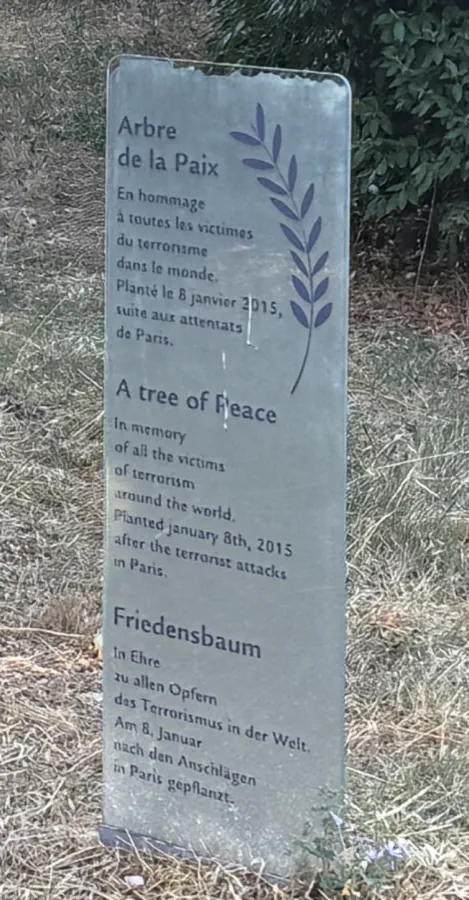
Arbre de la Paix
En hommage à toutes les victimes du terrorisme dans le monde. Planté le 8 janvier 2015, suite aux attentats de Paris.
EnglishA tree of Peace
In memory of all the victims of terrorism around the world. Planted january 8th, 2015 after the terrorist attacks in Paris.
DeutschFriedensbaum
In Ehre zu allen Opfern des Terrorismus in der Welt. Am 8. Januar nach den Anschlägen in Paris gepflanzt.
Why the olive thrives here
The olive tree (Olea europaea) is a child of the Mediterranean: it loves hot, dry summers and sun-warmed limestone soils – exactly what the climate of the Gard offers. It dislikes long periods of hard frost; for short spells it tolerates about −10 to −12 °C. Older, well-established trees in sheltered spots are considerably hardier – one reason why a tree like the olivier millénaire survived even cold Spanish winters and the move to France.
Are olive trees frost-hardy?
Only up to a point. What matters is not the odd cold night but prolonged frost combined with wet conditions. In mild wine-growing climates older olive trees get through the winter outdoors; in harsher places they need protection or winter quarters.
Practical notes for your visit
The Pont du Gard lies near Vers-Pont-du-Gard in the Gard département (Occitania), about 25 km from Nîmes and Avignon. The olive trees – including the thousand-year-old one and the tree of peace – stand freely accessible on the grounds near the aqueduct. For photographs, the soft light of early morning or late afternoon is worth the wait, when the limestone glows golden and the silvery olive leaves flash in the sun.